 Media Contact:
Anna Frances Gardner
View this press release as a PDF.
PRESS RELEASE
For Immediate Release:
Friday, August 14, 2026
Council for Quality Growth Hosts 550+ at 6th Annual INTERSECTION Quality Development Conference
23 Speakers and 7 Unique Content Sessions Explore AI’s Impact on the Built Environment
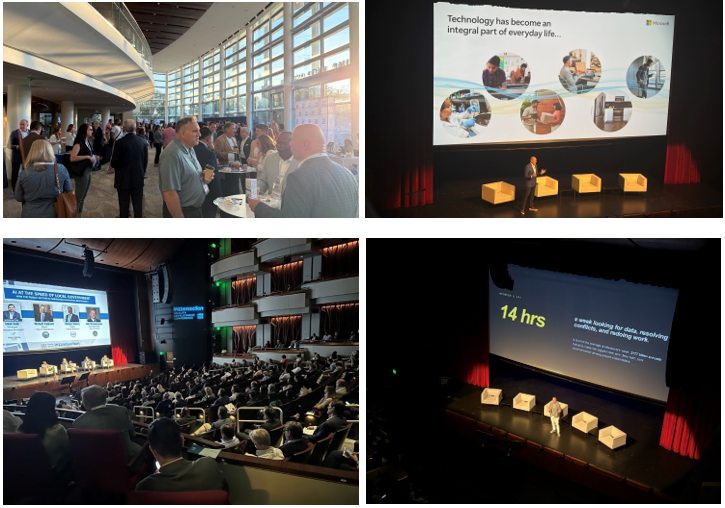
ATLANTA, GA – On August 14, 2026, the Council for Quality Growth hosted more than 550 attendees at the Sandy Springs Performing Arts Theater in City Springs for its 6th annual The INTERSECTION Quality Development Conference. This event is product of the Quality Growth Institute, the education arm of the Council. The INTERSECTION convened public policy and private business leaders from across the region to discuss critical issues facing metro Atlanta. The 2026 theme “The AI Era of the Built Environment is Here” set the stage for timely conversations about the technologies reshaping the future of development and land use. Doug Hooker, former Executive Director of the Atlanta Regional Commission, served as master of ceremonies.
Greg Lindsay, Urbanist-in-Residence at the University of Toronto’s School of Cities and two-time Jeopardy champion, delivered the opening keynote on Friday. He spoke on a paper he’s written titled “Chain Drain,” and presented his highly researched theories about the built environment and its resistance to learning and innovation. Lindsay described how fragmentation across the industry has created a system in which each part of the building process operates independently, ultimately limiting collaboration and learning. “The building industry is self-optimizing for market failure, meaning every link operates in its own silo that solves its own problems, and that, of course, reduces all the back and forth that leads to change orders, RFIs, and so forth and so on,” Lindsay said. He challenged attendees to consider how the industry can break down these silos and use AI and other emerging technologies to create a more connected, adaptive, and innovative built environment. He also cautioned that AI alone cannot solve the industry’s underlying structural challenges, noting, “If you simply apply AI to what we’re doing right now, you will just do more of it.” Lindsay encouraged attendees to look beyond simply adopting new technology and instead consider how it can be used to rethink workflows, improve collaboration, and help the industry learn from itself.
Greg was then joined by Dr. Barry Clark, Chief Technology Officer of Zero RFI, and Brent Reid, CEO of The Winter Companies, for a follow up conversation on how the industry is responding to AI and Greg Lindsay’s theory of “chain drain.” Part I, titled “AI at Work” featured a “New Development Stack” panel, moderated by Saba Loghman of Under New Management, which brought together leaders from Holder Construction, Alynea, Dominium, and AECOM to examine practical applications of AI across planning, design, permitting, and construction, and highlighted real-world use cases and opportunities to increase speed, efficiency, and decision-making throughout the development lifecycle. Part I concluded with a local government perspective on AI adoption, as Mayor Michael Caldwell of City of Woodstock, Mayor Michael Owens of City of Mableton, and Atlanta City Councilmember Matt Westmoreland discussed how public-sector leaders are embracing innovation responsibly to improve community development, infrastructure planning, permitting, constituent engagement, and service delivery while balancing accountability, transparency, and the unique responsibilities of public service.
Jonathan Noble, Sr. Director of Government Affairs and Infrastructure from Microsoft delivered the keynote address to begin Part II of the program. Noble joined The INTERSECTION from Silicon Valley, where he leads local and state affairs across the U.S. He shared Microsoft’s approach to data center development nationally, and the
role that data centers play in supporting AI innovation and economic growth for communities. Noble emphasized the growing demand for digital infrastructure and the rapid expansion of data centers, noting, “As our society is creating more data than ever, the amount of computing it takes to not only store that data, but then make it useful, is growing exponentially.” He explained that while AI is a significant driver of this growth, the broader expansion of cloud computing and digital technology is also increasing demand for data-center capacity. Noble also addressed the infrastructure, energy, water, workforce, and community considerations that come with this growth, emphasizing the importance of thoughtful planning and collaboration as communities prepare for the continued expansion of the digital economy.
Part II, titled “AI at Scale” continued the conversation around the infrastructure, energy, water, and regulatory considerations shaping the growth of the AI economy and data center development. The “Powering the AI Economy” panel, moderated by Katherine Zitsch, Director of Water Strategy at the Metro Atlanta Chamber, brought together representatives from Google, Georgia Power, and the Douglas County Chamber to examine the water-energy nexus of data center development and how utilities, developers, and communities are preparing for the infrastructure demands of the AI economy. The day concluded with “The Local Balancing Act of Data Center Regulation,” moderated by Mike Alexander, Chief Operating Officer of the Atlanta Regional Commission, where Commissioners Chakira Johnson of DeKalb County, Whitney Kenner Jones of Douglas County, and Kevin Lewis of Henry County discussed the complex considerations local governments face in regulating data center development, including energy demand, water resources, land use, infrastructure capacity, workforce investment, and community expectations.
Michael E. Paris, President & CEO, and Kathryn Jones, Vice President of Membership & Operations, of the Council for Quality Growth also delivered remarks. “This year’s INTERSECTION Conference made it clear that we’re no longer talking about something in the distant future,” said Michael Paris. “AI is here and is changing how we as an industry deliver projects, interact with local governments, and make decisions that can impact the trajectory of this region.” Mayor Rusty Paul offered a welcome from the City of Sandy Springs to kick off the day. The half-day conference featured 23 expert speakers and 7 unique content sessions, including 2 keynote addresses and 5 panel discussions.
The full digital program from the conference can be viewed and downloaded here: https://www.councilforqualitygrowth.org/wp-content/uploads/2026/08/QGI-INTERSECTION-2026-Program-FINAL.pdf
Attendees were Council for Quality Growth members and businesses representing various sectors of development, including real estate, infrastructure, economic development, government, and community organizations. Over 100 elected officials from the region’s 87 local governments were in the crowd at City Springs. The Council works at the intersection of public policy and private investment, and The INTERSECTION Conference brings these two sides together to discuss common challenges and uncover new solutions. In the effort to advance the mission of the Council for Quality Growth and the Quality Growth Institute, this event provides an educational platform for private business and local governments to learn from one another, share ideas, and foster strategic partnerships that move our region forward.
The INTERSECTION Conference is a product the Quality Growth Institute, the education arm of the Council for Quality Growth and an established 501(c)(3) non-profit organization in the state of Georgia. Through the Quality Growth Institute, conference attendees are eligible for credit hours towards occupational licensing, including Continuing Education (CE) real estate credit hours approved by the Georgia Real Estate Commission, Certification Maintenance (CM) AICP planning credit hours approved by the Georgia Planning Association, and Professional Development Hour (PDH) engineering credits.
A full recording of the event will become available in the coming days at www.CouncilforQualityGrowth.org/INTERSECTION.
About The INTERSECTION Quality Development Conference:
The INTERSECTION is the Council for Quality Growth’s Quality Development Conference that annually convenes the public and private sectors for an in-depth discussion of critical issues to our region and how we compare to national trends. The INTERSECTION was developed as a means of education and information for our members, partners, and other industry professionals, with a sharp focus on the most relevant trends and issues affecting the growth and development industry from year to year. The INTERSECTION Conference is a product the Quality Growth Institute, the education arm of the Council for Quality Growth and an established 501(c)(3) non-profit organization in the state of Georgia. https://www.councilforqualitygrowth.org/INTERSECTION
About the Council for Quality Growth:
The Council for Quality Growth is a trade organization that works to ensure continued growth and economic success for generations to come by providing advocacy, information, and education to its members. In its 41st year, the Council is committed to the mission of promoting balanced and responsible growth and is proactively involved in the formulation of policy and legislation critical to the growth and development industry. The Council addresses, head-on, strategic economic planning, infrastructure needs, and tough quality-of-life issues throughout the metro Atlanta region and state. For more information, please visit http://www.councilforqualitygrowth.org.
###